



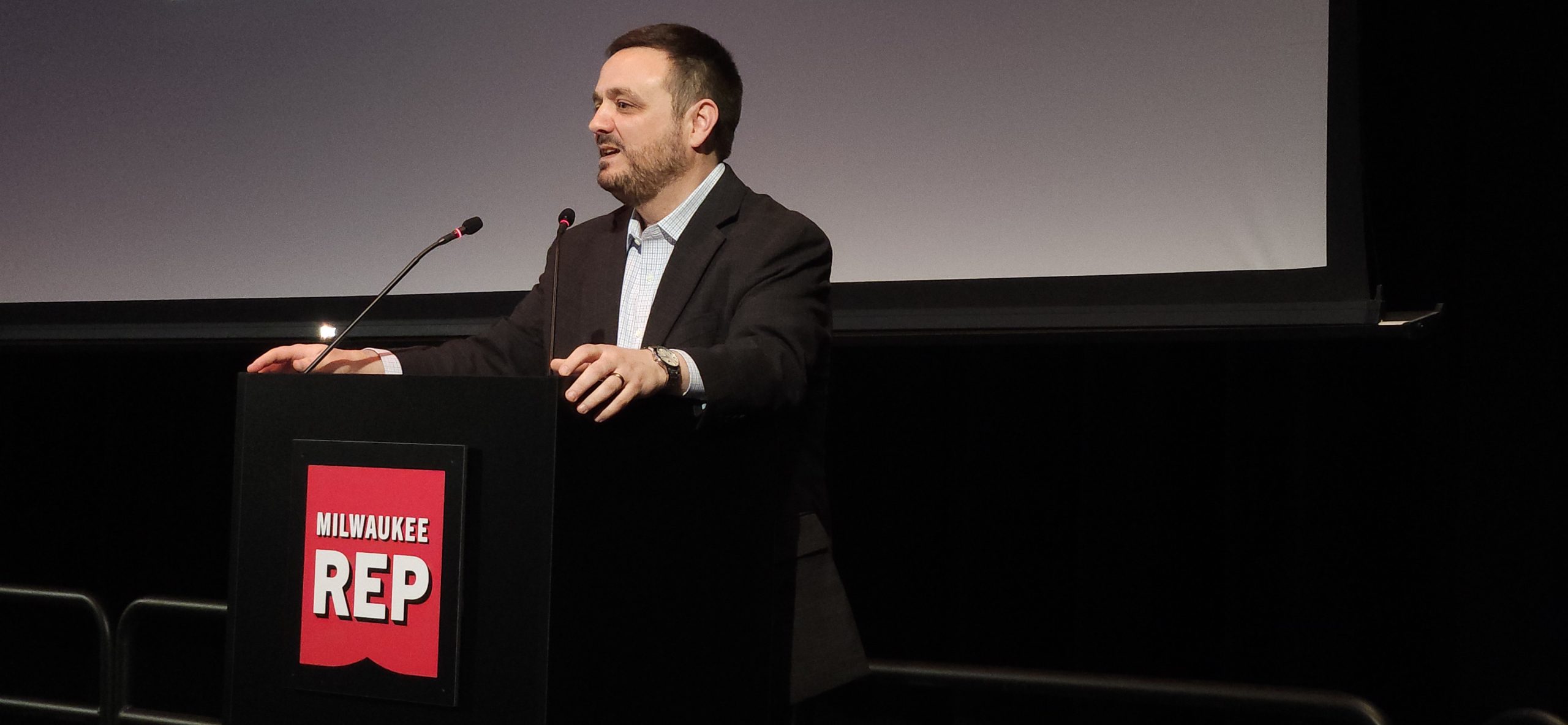
Chad Bauman reflections at Theater Leader Summit welcome dinner
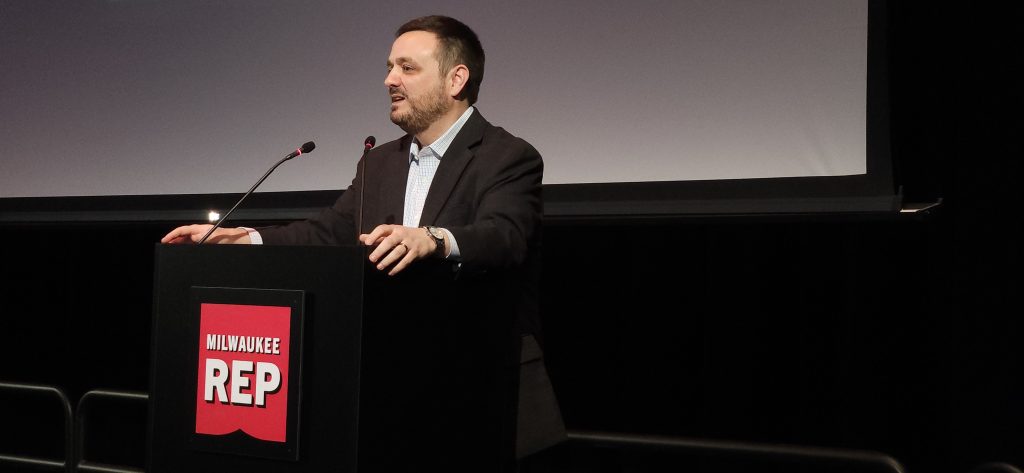
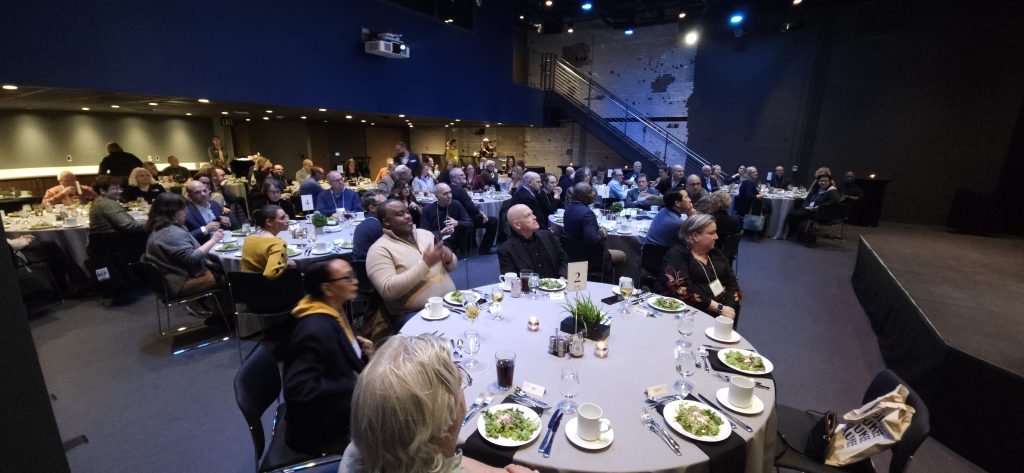
Milwaukee, March 4, 2026 — Chad Bauman, Ellen & Joe Checota Executive Director of the Milwaukee Repertory Theater, provided welcoming remarks to more than 80 artistic leaders, critics, and journalists March 4, 2026, the first day of a 3-day summit to consider the future of American regional theater.
Bauman’s welcoming remarks, entitled: In the Arena: Leadership, Love and the American Theater, were posted on his Substack Leading Creatively. Those deeply considered and impassioned thoughts are also included here.
ATCA members were supported by the Milwaukee Rep to be part of the convening in integrated and parallel sessions over the course of the summit. (For additional details on the ATCA member activities as part of the summit, see the ATCA event page.)
****************************************
“Welcome to Milwaukee Repertory Theater and the Associated Bank Theater Center.
We are grateful for this rare opportunity as theater leaders to step away from our daily responsibilities and gather together. The fact that we are here reflects a shared belief that American theater matters, and that how we lead matters just as much.
We are equally honored to be joined by members of the American Theater Critics/Journalists Association, whose voices help shape the national conversation about our work and its impact.
As I prepared for our time together, I found myself thinking about conversations I once had with Zelda Fichandler. When I asked her what it was like to lead a regional theater known for transferring work to Broadway, she pushed back. Regional theaters, she reminded me, were not founded to serve New York, but to serve their own communities.
For Zelda, success was measured by the depth of that relationship. Do people see themselves onstage, feel both challenged and affirmed, and leave changed in ways subtle but lasting? A theater that can do this consistently, she believed, is fulfilling its highest purpose.
Seen through that lens, success is not a destination but a practice. While our goals may be shared, the paths we take will be as distinct as the communities we serve. Those differences are opportunities to learn from one another and strengthen the field through connection. It is from that place of shared purpose and varied practice that we are here today.
Loving Our Audiences
At the heart of theater leadership is a simple but demanding truth: to do this work well, we must fall deeply in love with all the communities we serve.
We must love our audiences, and they must feel that love. When it is real, it creates trust. And trust transforms a theater from a place people attend into a place where they belong.
Belonging does not happen by accident. It is built through listening as much as speaking, through responding as much as leading. When people feel seen and respected, they do not simply buy tickets. They invest. They show up as partners in the life of the institution, and that relationship shapes every artistic and civic choice we make.
Some may believe that accessibility and broad welcome signal artistic compromise. We believe the opposite is true. To care for our audiences is not to retreat from responsibility, but to honor it. Loving our communities is not a failure of courage, but the foundation of it.
Programming from the Light
Our love must be visible not only in how we welcome people, but in what we offer to sustain their spirits.
Our communities have endured unprecedented trauma in recent years: a global pandemic, racial violence, housing instability, economic upheaval, political polarization, and climate disasters. Our ability to process trauma is finite. The weight of these crises has contributed to a nationwide mental health emergency. People are frightened, exhausted, and searching for steadiness.
In moments like these, we are not passive witnesses, but rather have the power and responsibility to offer light.
Programming from the light does not mean ignoring pain or hard truths. It means refusing to let despair define the outcome. Hope, empathy, and connection are not luxuries, but essential to how people endure. Hope may be the hardest thing to offer right now, but it is also the most necessary. It requires facing darkness directly and choosing to move toward something better.
Offering light also means expanding whose voices are heard, including those long excluded. Our work and our communities are weakened when those voices are absent. We do this not out of obligation, but because the future we are trying to build together cannot exist without all of us.
In the wake of September 11, Come From Away was created. Rather than centering violence or fear, it tells a story of ordinary people choosing care and generosity. Its power lies in its insistence that even after profound tragedy, connection endures and becomes a source of resilience. The theater has the capacity to help communities heal. Hope, when offered honestly, is not naïve, but rather an act of leadership.
All Are Welcome
If programming from the light is about what we offer, then welcoming from the heart is about who we invite into our homes.
Supreme Court Justices Scalia and Ginsburg were avid theatergoers, subscribing together for many years. It was well known that these ideological opposites were also close friends. Scalia said their bond endured because they challenged ideas while loving each other.
It is a privilege to produce theater in a politically “purple” state. Our audiences span the full ideological spectrum. What unites them is the desire to come together for a shared live experience that entertains while deepening empathy and understanding. Our theaters are among the rare community assets that can unite us.
In advocating for nonprofit status, Zelda said theaters were “like the university, church, and library, instruments of civilization.” Like the church, we should welcome all. What real impact do we have if our goal is to preach to the choir every Sunday?
At our best, we create spaces where people encounter ideas that challenge them without being alienated, where disagreement can coexist with respect, and where curiosity is valued over certainty. We model the kind of civil discourse our democracy depends on by inviting audiences not to arrive with answers, but to leave with questions, greater compassion, and a deeper understanding of one another.
What Endures and What Emerges
The great playwrights from Sophocles to August Wilson are not produced because they are safely canonized, but because they still speak to something essential in us. Their work asks timeless questions, refusing to let us look away from who we are, how we treat one another, and what we owe the world we inhabit. When staged with conviction, these plays are not retreats into the past, but confrontations with the present.
At the same time, the soul is not a closed archive. Each generation arrives with its own language and urgencies, and new work gives shape to what has not yet been named. These voices do not replace the canon; they expand the conversation.
Audiences deserve both. It is an ongoing dialogue between what has endured and what is still becoming, between the stories that shaped us and the ones shaping us now. We must reject the false choice between artistic risk and financial stability. Audiences can be challenged and delighted, often at the same time. In fact, that tension is where some of the most powerful work lives.
Since reopening after the pandemic, Milwaukee Rep has produced world premieres by Dael Orlandersmith (twice), Catherine Trieschmann, Eleanor Burgess, Lloyd Suh, Eric Simonson, Gordon Gano, Idris Goodwin, Craig Lucas, Daniel Messe, Mark Clements, and Deanie Vallone. We have also recently announced a new $2 million commitment to new work, which will see 6 new plays produced in the next 2 years as well as 3 new commissions. This work is bold, boundary-pushing, and deeply challenging, and it is being embraced by a growing audience. These productions are among our best attended and among the most produced plays in the country today.
We can produce known work and new work. We can entertain and provoke. We can do many things at once. That diversity is one of our greatest strengths.
Progress Without Abandonment
Every era is shaped by a tension between tearing down and building up—and the American theater is no exception.
Change doesn’t succeed just because it’s urgent. It succeeds when it’s paced well and carried forward by the people it affects. Moving fast can feel decisive, but speed without stability often leaves behind broken systems, drained budgets, and communities with fewer options than before.
Lasting change means knowing what can be rebuilt and what must be kept standing while it’s improved. That requires careful planning and a willingness to bring people along rather than racing ahead of them. Going slowly can become an excuse for avoiding hard decisions, but moving too fast can create damage that takes years to undo.
Leaders must set the right pace: fast enough to address real harm, steady enough to protect institutions people rely on, and responsible enough to leave the community stronger than before.
With Hope and Gratitude
Beneath discussions of programming, governance, and audience development lie fundamentally different visions of how we should relate to the people we are privileged to serve.
One belief is that theaters exist in deep relationship with their diverse communities; that trust is earned, not demanded; and that change endures when it is rooted in compassion, curiosity, and mutual respect. From this perspective, audiences are not obstacles to progress, but partners in it.
Another approach, articulated by respected voices in our field, frames the relationship between theater and audience differently. Here, disruption becomes the primary objective. The audience is something to be confronted, corrected, or even replaced, rather than brought along.
Time will settle this debate. A new generation of leaders will make their own choices, shaped by urgency, conviction, and lived experience—and that is as it should be. But history is clear about one thing: theaters endure because they create belonging. Change that lasts is not imposed; it is invited, modeled, and sustained through relationships strong enough to hold disagreement without breaking.
We are all in the arena. The question before us is not whether American theater will change—it must and it will—but whether that change leaves behind a field that is stronger, more trusted and equitable, and deeply woven into civic life. We believe that when we choose love over antagonism, invitation over exclusion, and hope over despair, we give our field its best chance not merely to survive this moment, but to thrive beyond it.
Thank you for the work you do, and for the care, courage, and imagination you bring to it each day. We are showing up for our artists, our audiences, and our communities in good faith. We are grateful to gather with you, to learn from you, and to serve alongside you. The work ahead is difficult, but it matters, and it is work none of us has to do alone.”
— Submitted by Martha Wade Steketee, ATCA attendee at Theater Leader Summit 2026.
Sorry, the comment form is closed at this time.