




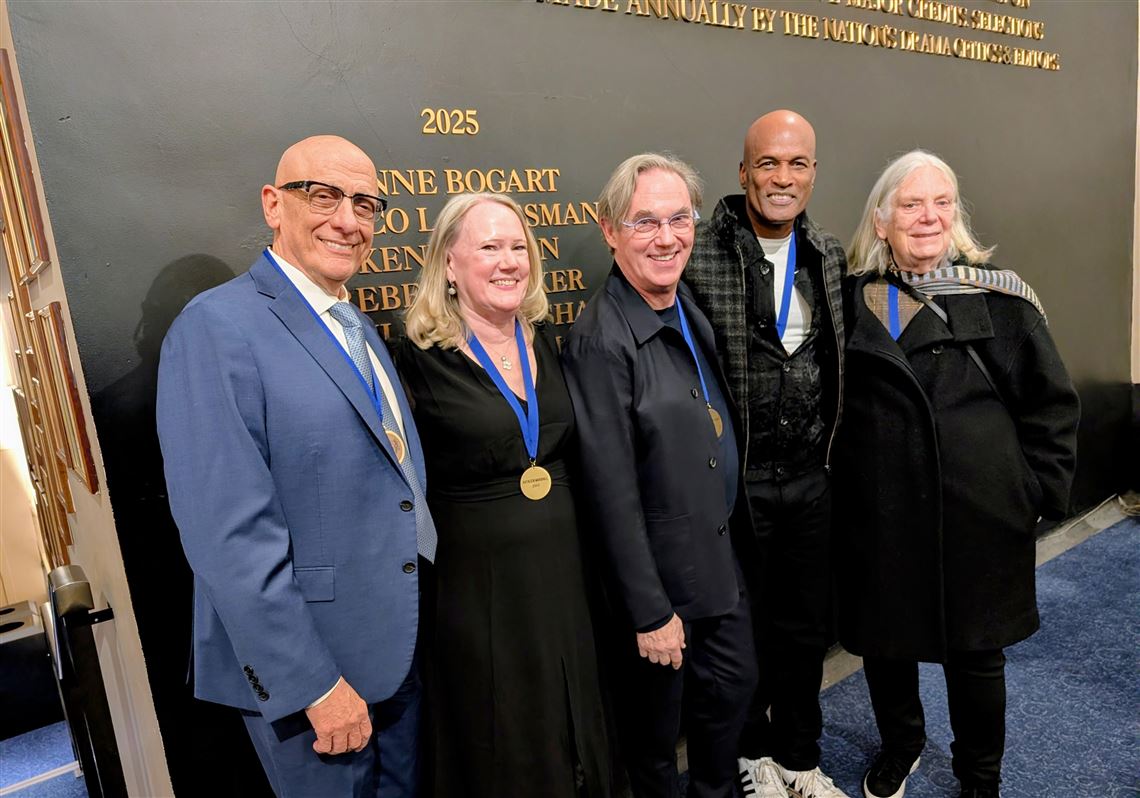
Pittsburgh natives Kathleen Marshall and Tom Viola among inductees to Theater Hall of Fame
[Text based on December 4, 2025 Pittsburgh Post-Gazette article by ATCA member Chris Rawson. Hall of Fame history through the decades outlined here.]
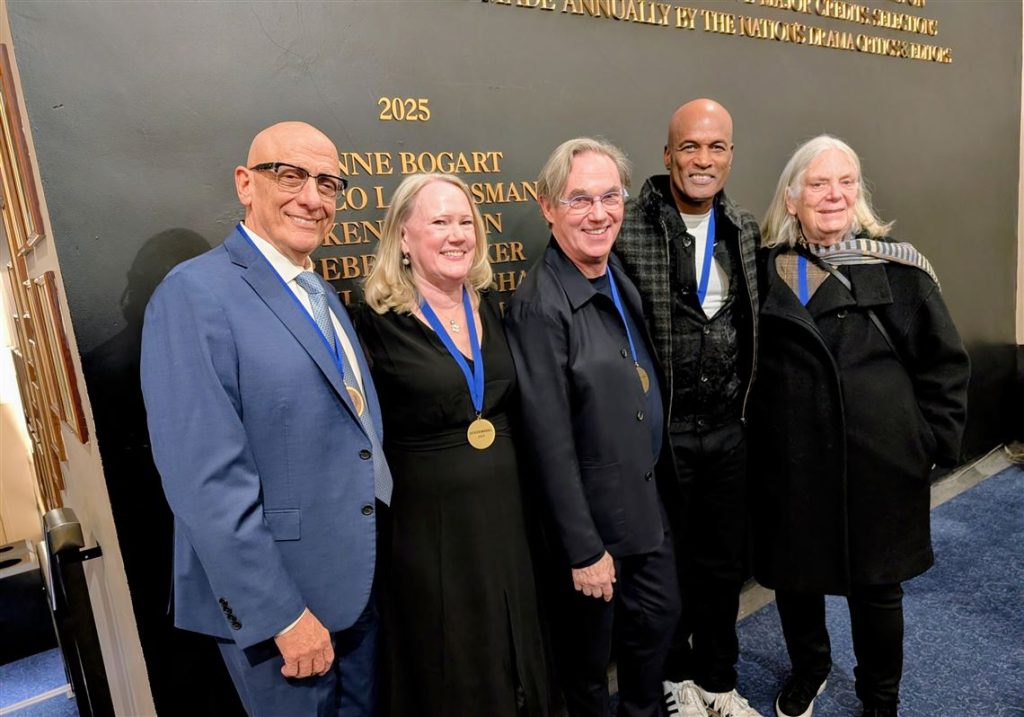
NEW YORK – For how many skills are involved in theatrical excellence, consider the annual induction ceremony at the Theater Hall of Fame at the Gershwin Theatre on Broadway.
The eight inducted in the hall’s 54th year, listed in alphabetical order, were director Anne Bogart, producer Rocco Landesman, performer Rebecca Luker, director-producer Kenny Leon, director-choreographer Kathleen Marshall, designer Paul Tazewell, performer Richard Thomas and fundraiser Tom Viola.
But those labels are just the simplest ones. How many skills must a producer or director have? Take a closer look at these eight and you’ll also see more than one mentor, author, teacher, critic, writer, executive, costumer, professor and creative servant of the theatrical world, not to mention at least one very successful gambler (see below).
The 2025 class also features numerous Pittsburgh connections. Kathleen Marshall and Tom Viola are Pittsburgh natives; Kenny Leon can be called a Pittsburgher by adoption, because of his close association with playwright August Wilson; Anne Bogart’s plays have been produced in Pittsburgh, mainly at City Theatre; Paul Tazewell spent some years as a professor of costume at Carnegie Mellon University; and Richard Thomas has played Scrooge for Pittsburgh CLO.
As usual, the audience for the 2025 induction in November was intimate, just 125-150 friends and families, plus previously inducted hall members and theatrical insiders. They gathered in a soaring upper lobby of the Gershwin, beneath high walls where 605 members’ names (many more than eight were inducted in the earliest years) are emblazoned in raised golden letters.
The emcee for the evening was choreographer-director and hall member Susan Stroman, with Terry Hodge Taylor as hall producer. Hall of fame selections are made annually by an electorate of 200 national theater critics and members. The minimum qualifications to get on the ballot are at least five major credits (not just from Broadway) spread over a career of at least 25 years.
Each 2025 inductee was presented by someone of their own choosing. For Marshall, who grew up in Squirrel Hill (Falk School and Allderdice High School, early jobs at Pittsburgh CLO and Pittsburgh Playhouse), the choice was her brother, stage and movie director Rob Marshall (same schools, CMU, Broadway, “Chicago” movie, etc.)
As many inductors do, Rob started with a list of Kathleen’s many accomplishments, from Pittsburgh to national (20 Broadway shows, nine Tony Award nominations, three Tonys) and international (an Olivier Award in London). But he mainly focused on how the two of them and their sister, Maura, began as young kids doing musical theater numbers at home in Squirrel Hill, with props sticking out from every corner of the living room.
That ”sense of joy and humor and play is still central to her work,” he said. “It always bursts off the stage.”
Pointing to their watching parents, Bob and Anne, he claimed that “it flies with their unconditional love. We also celebrate you.”
Looking at her whole family, her eyes teary, Kathleen spoke of having worked with others in this year’s class and with other hall members already on the walls.
She remembered having been called in 1992 by her brother in Toronto, where he was choreographing “Kiss of the Spider Woman” with Chita Rivera and turning it into the hit it became in London and New York. Would she come up and work with them? She did, and her career blossomed.
Inducting Viola was Danny Whitman, his successor as executive director of Broadway Cares/Equity Fights AIDS. Viola led the group for 36 years until his retirement in 2024 and raised some $300 million. “He’s had as long a run as ‘Phantom of the Opera,’” Whitman joked.
A native of Bethel Park and Zelienople, Viola moved to New York as a performer, then became assistant to the president of Actors Equity (the actors union) Colleen Dewhurst.
“I cannot ever find a pencil,” she objected when offered the job. Viola could. She sent him to work on gathering support to fight AIDS, and soon he was unifying the efforts of the union and Broadway producers.
Viola devised many fundraising events and groups that have become central to the Broadway year.
“It helped Tom turn passionate ideas into action,” Whitman said. He also became “a mentor to many actors, what Stephen Sondheim became to many composers.”
In response, Viola recalled his first visit to the Gershwin Theatre, then called the Uris Theatre, in 1973, when he was 19 and the first names were on the walls — “ artists of such brilliance.” He thanked the hall for this “great unexpected honor,” claiming his name “represents thousands and thousands and thousands of those who made BC/EFA succeed.”
Leon was presented by Glenda McNeal, who pointed out that he has also been artistic director of the Alliance Theatre in Atlanta and founder of True Colors Theatre. Since 2004 he has directed 18 Broadway shows, winning seven Tony nominations and the Tony itself for “A Raisin in the Sun.” He wrote a fine memoir, “Take You Wherever You Go.”
In response, Leon talked about how artists serve each other, naming several there that night.
“We’re the laboratory of living on the planet,” he said. Working together, “our job is to make a more beautiful world” for our grandchildren.
In inducting Bogart, Salem Ali, a former student and now theater leader, said, “Art is never about comfort, it’s about awakening.” Bogart is most famous for developing the SITI Company with Tadashi Suzuki.
A professor at Columbia University and author of four books on theater making, she expanded the Viewpoints used in theater training and became a mentor to many.
As Ali said, she teaches “not how to direct but how to pay attention … for ensemble creation.” She helps in “training the body to think and the mind to move,” and she shows that “process is as important as product.”
Bogart “shaped a generation,” he said. “She didn’t give us answers, she gave us questions.” She shows us “how to stay alive in the world.”
“To be chosen on this wall is extraordinary,” Bogart replied. She quoted Picasso, that “the first stroke on a canvas is always a mistake.” She asked, “Where do I leave off and where do you begin? … You start and I’ll edit what you do.” She accepted this honor “as part of a larger ensemble.”
The most humorous induction was of Richard Thomas by Jeffrey Richards. Richards started out on Broadway as an press agent but since 2020 has produced more than 50 shows, winning fistfuls of Tony nominations and eight Tonys. He focused on how Thomas is best known for having played much younger than himself as John-Boy in “The Waltons” for 122 episodes.
But well before TV, Thomas made his Broadway debut at age 7 in “Sunrise at Campobello.” He’s done 15 Broadway shows and also acted on stage all over the country, playing many classic roles, including O’Neill, Ibsen, Albee, Mamet and lots of Shakespeare — plus, one-man shows as Tom Paine and Mark Twain. He said Thomas has worked “nearly 70 years in the theater, but will be just 35 on his next birthday.”
Thomas, 74, made a few jokes about his supposed age, but mainly expressed his pleasure at joining the hall of fame. “This is a big thing. It’s too much, really.”
Theater is “just a big river we’re all swimming in.” He remembered the first time he was allowed to stay late enough to join the “Campobello” curtain call and look out on a laughing, happy audience.
“Broadway is the shining side of the coin,” he said, but the other side is also important, the theaters all over the country. His goal: “I hope one day I’ll make it to play Firs” (the oldest character in Chekhov).
It fell to actor Danny Burstein to induct his wife, the popular musical comedy actor Rebecca Luker, who died in 2020.
“I’ve tried to think of what Rebecca might have said,” so he began with her many thanks. Most poignantly, he said, was that in performance “she opened her mouth and her heart fell out.”
Costume designer Paul Tazewell was at the last minute unable to attend because he was dealing with the upcoming release of the movie “Wicked: For Good.” That’s the sequel to “Wicked,” for which he also designed costumes and won an Oscar. This hall induction is for his stage work, of course, which includes a fistful of Tony nominations. He will be formally inducted next year.
“Gambler” may be most surprising in the list of helpful theatrical skills, but the stage demands gambling as you fight through childhood, schools, regional theaters, casting and careers that go up and down. The most famous gambler in this group was producer Rocco Landesman, who ran a stock fund, owned baseball teams and hit it big owning racehorses and betting at the track.
For him, the inductor was Frank Rich, a hall member himself and famous as theater critic of The New York Times. Landesman told Rich he had a spreadsheet that showed “his negative reviews cost me a total of $12 million.”
Landesman once suggested that he and Rich change jobs for some months, and Jim Binger, who oversaw Landesman in running the Jujamcyn Theaters, was interested, but Rich’s editor said no.
It would have been an interesting gamble. As to betting at the track, Landesman once won $138,000 on a single race and gained enough money to move from being a professor of theater at Yale to being a Broadway producer, a profession where “it’s better to be lucky than smart.”
Theater is the biggest bet of all. Landesman told a few stories about negotiating to get a play into one theater or another. But as a producer and co-owner of Jujamcyn, his serious accomplishment was to help bring interesting theater back to Broadway, as his winning shows suggest, including “Angels in America,” “Into the Woods,” and “The Piano Lesson” among other August Wilson plays.
“I didn’t want this honor,” Landesman said, “since to get it you have to be of a certain age.” Now in his 70s, he wondered, “Do I see the pearly gates?” He then speculated on what he’d be charged with: the expense of theater tickets? Betraying artists? Disappointing actors?
“I couldn’t help it,” he’d have to say: “I was a Broadway producer.”
— Submitted by Chris Rawson, lightly edited by Martha Wade Steketee
Sorry, the comment form is closed at this time.