
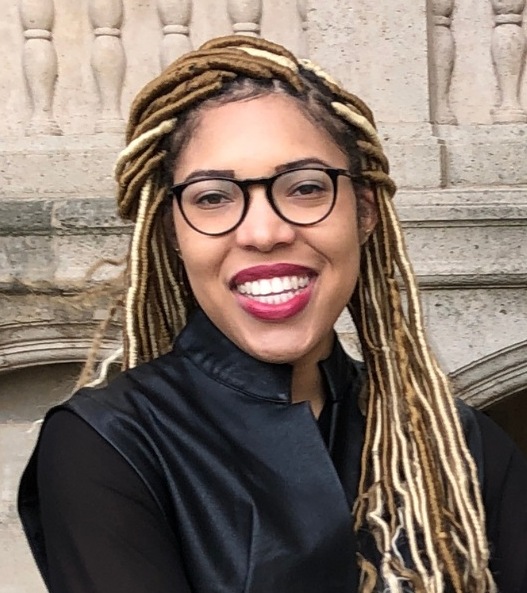
A Conversation with 2026 Edward Medina Prize Recipient Anastazia X. Neely
On Saturday, November 14, 2026, the American Theatre Critics Association will present Anastazia X. Neely with the 2026 Edward Medina Prize in Cultural Criticism in a ceremony honoring both Neely’s astute work as a journalist and the five-year anniversary of the award.
It should come as no surprise that Neely — a writer born in Greece, raised in Utah, North Dakota, and Alaska, and now based in Harlem, known professionally as simply Anastazia X — brings an urbane confidence to her criticism. Her writing and social media commentary are accessible, well-informed, and delivered to readers with a level of passion one can feel leaping out of the screen.
What’s even more impressive? In the half-decade history of the award, Neely is the first recipient to win solely based on pieces she submitted from her own publication, Black Star Reviews, which was established in 2024. In the publication’s own words, Black Star Reviews is a digital platform striving to “chart the constellation of black brilliance in nyc and beyond by offering uplifting commentary on theatrical shows, art exhibitions and other cultural performances by black creatives.” The necessity of such a mission is undeniable. And we, as fellow critics, culture vultures, human beings deeply invested in the health of performance, ought to pay close attention.
The following text (edited and condensed for clarity) is an interview of Neely by Brittani Samuel, the inaugural Medina Prize winner, in which they discuss Neely’s decision to forge her own journalistic path, the sting of culturally insensitive critiques, and what the universe has in store for Black Star Reviews.
I’m embarrassed to say I wasn’t familiar with your work before Black Star Reviews. Yet you’re so good — a personable, smart, well-observed writer. Did you formally train as a journalist, or are you self-taught?
I am self-taught, but deeply inspired by a lot of critics. For a while I was calling myself a culture writer, and that was a nod to Wesley Morris and Jenna Wortham. I used to love their New York Times podcast. I was a journalism major for one semester in college (I was obsessed with Soledad O’Brien’s Black in America documentary series in high school), but then I changed my major to education.
Why education? And then, how did you transition back to journalism, and specifically, to writing about art?
My big thing was “I’m gonna close the achievement gap,” which I laugh at now because how was I, one person, going to do that? But I was determined to, so I was a teacher for many years, training in Virginia, because Hampton University is my alma mater, and then moving to New York. When I came to New York, I tried to escape teaching briefly. I got my graduate degree in public administration at Columbia University because I thought I could make more effective change that way, but I returned to the classroom from about 2013 to 2023 — ten years. Educating during COVID came with many difficulties and I knew it wasn’t the right fit anymore, but when I quit, I didn’t know what I was going to do next. I was adjuncting just for a little structure in my life, but when I would go to a lesson observation, I’d finish up on the Upper East Side at 9:30 a.m. with nothing to do. So, I would end up in a museum. Or, if I was in Midtown in the afternoon, I would go try to get a rush ticket for a Wednesday matinee.
Wow! Talk about finding purpose in the pause.
I would go to a museum, show, or exhibition, and I’d want to call my friends after seeing something amazing. But they were, of course, at work. It would be the middle of the day! So I just started writing down everything I was thinking — putting pen to paper as a way to get my reactions out.
I needed the universe to show me what I was supposed to be doing, and it didn’t take too long at all. The part that took long was accepting it. “Okay, you want to write about art? What are you going to do with that? Where does it go from there?”
You did not wait for anyone to give you an opportunity, you built your own. Once you made up your mind to start writing about art, was it always your plan to create your own platform?
I honestly figured that, because I had no credits and no degree, nobody would publish me. I truly didn’t know. I met the film critic Richard Brody the other day, and I was embarrassed to admit to him that I don’t know how to pitch. But I really don’t. There was fear around this idea for me: I know how to write. I don’t know how to pitch. I’m not opposed to writing for other platforms, and I’d love to work with an editor. But when I started, I just figured I would probably need to establish some credibility so that if I ever do learn how to pitch, then people can see my work.
Can we go a little further back to young Anastazia? Because there are many things to do with a free afternoon in Manhattan, but you kept choosing art. I know you traveled often because your father was in the military, but did you always gravitate toward creative arts as a child, too?
Shout out to my mom. It was very important to her that I be well-rounded — I was in piano, swimming lessons — so I’m no stranger to museums or theatre. I also grew up in the church and would attend multiple days a week, so the pageantry of Christmas and Easter shows had a lot of influence.
I’ve always loved theatre, and since I wasn’t raised in New York, I grew up seeing a lot of regional productions. I didn’t even necessarily have an understanding of what Broadway was. I remember seeing Once on This Island at a community theatre in Utah where they had to scrape together enough Black people to make the islanders. This military guy who was active in our church wanted to do arts on the side, so he invited the whole church to see him in the show as Papa Ge. (He was fantastic, by the way.) I remember seeing that show and making my mom find the soundtrack. I just thought it was so amazing. I also remember I saw Rent in Alaska when I was very young. My mom had no idea what it was, and if she had known, she wouldn’t have taken me.
Why were we all watching Rent way, way too young?
I know, I know. So, I just have to shout out my mom because engaging with art wasn’t new to me. I’ve heard people say they don’t feel comfortable or welcomed in theatre, or museums, or galleries, and that just hasn’t been my experience. I don’t mind walking into a room and letting people know that I’m meant to be here.
Let’s talk a little more about your choice to focus on Black talent on your platform.
Black art is what interests me. Even before I started Black Star Reviews, if there was a Black show on Broadway, I would go see it. I would hate it when I missed something. Or, when my people came to visit, I would try to find something they’d enjoy. When I go to the Met, I walk right through the Greco-Roman area, no shade. I just didn’t come here for that. I came to see and learn my people.
Has anyone ever advised you against this? Or made you feel pigeonholed by this choice?
I’ve been misled by reviews before. There is a specific example from before 2020 of a show the New York Times said was a “must-see” and gave a Critic’s Pick. So I obviously went to see it, but very quickly felt trapped. Get me out of here! I don’t want to be here. I was having very strong and visceral reactions. I’m sure the Times did not mean to personally harm me, but I was hurt in that theatre. I want to be able to provide a Black perspective for Black people, because these shows aren’t cheap. These experiences take your time, and I would like for people to know what they’re getting into. And I want there to be a record. I know that I’m just one voice. I don’t speak for all Black people, but I can do something. I don’t feel pigeonholed at all. I feel like I’m in my own bag.
You’ve already accomplished so much. But what is your ultimate dream for the publication? Where can people who read this interview help take Black Star Reviews?
I envision an award ceremony. I envision artist grants. I envision a separate foundation that helps kids get involved, helps them be artists or helps them write about art. I think it has space to become something much larger. I’m also a millennial, so I would love to see a printed publication. That would matter to me, to be able to hold Black Star Reviews in my hand, put it on my bookshelf. You know, I think that would be dope. I just haven’t figured it out…yet.
— submitted by Brittani Samuel via Nate Hinkle, lightly edited by Martha Wade Steketee.
Sorry, the comment form is closed at this time.